
Reviewed · CITY WALLS & OLD TOWN
Dubrovnik Discovery Old Town Walking Tour
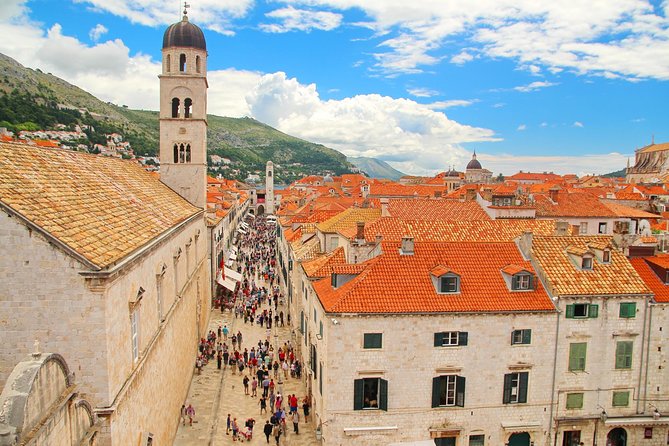
Dubrovnik’s stones tell stories fast. This Old Town walking tour packs major landmarks and a few smarter-side stops into about 1.5 hours, with a licensed local guide talking you through 1,400 years of port-city life. You’ll cover the monuments visitors line up for, but also the in-between moments that help everything click.
I especially like two things. First, the tour is guided by a Croatian Ministry of Tourism licensed expert, and the talk stays clear and practical. Second, you get a setup made for listening: use audio headsets in groups of 4+, which helps when streets get crowded.
The main downside is also the easiest to plan for: it’s a walk on uneven stone streets. In rain, the walkways can get slippery, and at peak times the group can feel a bit hurried as you move from square to square.
In This Review
- Key highlights worth your attention
- Why $24.19 for 90 minutes feels like a fair deal
- Meeting at Brsalje: finding the orange umbrella and starting on time
- Pile area to the first big landmarks: the tour’s momentum
- Franciscan Monastery and the early flow of the walk
- Orlando’s Column: freedom shown in stone
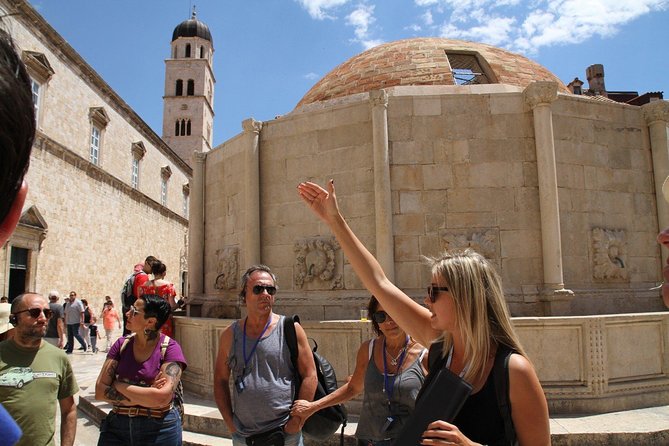
- Onofrio’s Fountain and the city’s water story
- Stradun, palaces, and the power centers you can actually picture
- Rector’s Palace: where governance feels real
- Sponza Palace: commerce and civic life in one view
- The Cathedral of the Assumption area after 1667
- Luza Square: the heart of the Old Town in one stop
- Brsalje Street and Pile Gate: orientation without extra entry lines
- Brsalje Street for a quick “what you’ll see” reset
- Pile Gate: the main western entrance
- Porat Dubrovnik: ending near the water with easy next steps
- Group size, pace, and why weather matters more than you think
- What makes the guides so effective on this route
- Tips to get the most from your 1.5-hour walk
- Should you book this Dubrovnik Discovery Old Town Walking Tour?
- FAQ
- How long is the Dubrovnik Discovery Old Town Walking Tour?
- What language is the tour offered in?
- Where do I meet the guide?
- Is the tour ticket a mobile ticket?
- Are audio headsets included?
- Which sites are part of the route?
- Is admission included for the stops?
- What if the weather is bad?
- Can I cancel and get a full refund?
Key highlights worth your attention
- Licensed local guide, English-speaking, with stories that connect monuments to daily life and bigger events
- Audio headsets for groups of 4+, so you can hear without craning your neck
- Orlando’s Column and Onofrio’s Fountain explained in context, not just named on a map
- Rector’s Palace, Sponza Palace, and the Cathedral of the Assumption area all in one walkable sweep
- Route includes Pile Gate and Luza Square, so you get both the entry point and the heart of the Old Town
- Finish near the old town port, handy for continuing your day by foot or hopping elsewhere
More time up on the ramparts and inside the Old Town
- Dubrovnik: Old Town Walking Tour★ 4.8 · 5,174 reviews
- Dubrovnik Discovery Old Town Walking Tour★ 5.0 · 4,458 reviews
- Dubrovnik Old Town History Walking Tour★ 5.0 · 1,684 reviews
- Dubrovnik: City Walls Early Morning or Sunset Walking Tour★ 4.8 · 1,523 reviews
Why $24.19 for 90 minutes feels like a fair deal
At about $24.19 per person for roughly 1 hour 30 minutes, this tour lands in the sweet spot for Dubrovnik. You’re not buying museum entry or paying for transport. You’re buying an organized route and a real local guide who can point out what matters, what to notice, and why the city was shaped the way it was.
That value also comes from the format. In a place like Dubrovnik, the difference between wandering and learning is huge. The old streets look similar until someone gives you the keys: where civic power sat, how the city got water, and how major events left visible scars in the architecture. You also get audio headsets in larger groups, which is one of those details that quietly improves the whole experience.
One more small factor: the tour is commonly booked about 21 days ahead on average. That’s a hint that it runs popular times. If your schedule is tight, it’s worth locking in an early date you like instead of gambling on walk-up availability.
Meeting at Brsalje: finding the orange umbrella and starting on time
Your start is simple and easy to repeat once you know the landmark. Meet at Dubrovnik Walks Orange umbrella, Brsalje ul. 8, 20000, Dubrovnik. The guide gathers the group there for a quick intro before you set off.
A tip that comes up again and again in the feedback: look for the orange umbrella. On busy mornings, that little visual cue saves you from circling the area or showing up late and flustered.
The walk ends near the old town port. In practical terms, that’s helpful because you finish in a part of Dubrovnik that makes it easy to keep exploring without retracing your steps back toward the main entrance.
Pile area to the first big landmarks: the tour’s momentum
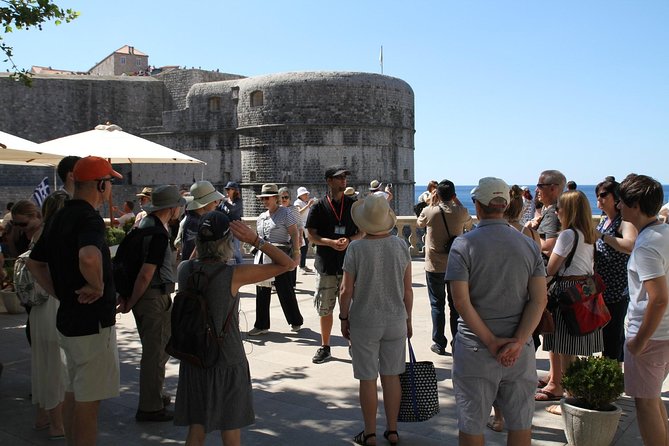
The tour begins in the Pile area, and that’s smart. Pile is one of the main entry zones to the Old Town, so your “first impression” becomes your orientation tool.
From there, you pass key stops that tell the story of how Dubrovnik operated as a working city, not just a pretty postcard.
Franciscan Monastery and the early flow of the walk
You’ll see the Franciscan Monastery area as you get deeper into Old Town. The route is built to give you quick context on what you’re looking at before you hit the civic and waterworks landmarks.
This matters because Dubrovnik’s layout can feel overwhelming if you’re only looking at facades. With a guide, the streets start to behave like a timeline: you’re moving through eras while still staying on foot and on schedule.
Dubrovnik on foot, a few more routes off the Stradun
- Dubrovnik: Game of Thrones Walking Tour
★ 5.0 · 1,732 reviews - Dubrovnik: Ancient City Walls & Wars Walking Tour
★ 5.0 · 1,270 reviews - Dubrovnik: City Walls, Old Town Walking Tour & Adriatic View
★ 4.9 · 982 reviews - Dubrovnik: Game of Thrones Walking Tour
★ 4.9 · 981 reviews - ‘Game of Thrones’ Walking Tour in Dubrovnik
★ 4.5 · 945 reviews
Orlando’s Column: freedom shown in stone
Orlando’s Column is one of the monuments that makes sense once you hear what it represents. The tour explains it as a symbol tied to Dubrovnik’s long-standing freedom and sovereignty.
If you’ve been in other European cities where symbols feel generic, this is different. The column isn’t just decorative. It’s political language in stone, placed where people could see it. It also helps you connect the city’s identity to the way later landmarks were built and rebuilt after disasters.
Onofrio’s Fountain and the city’s water story
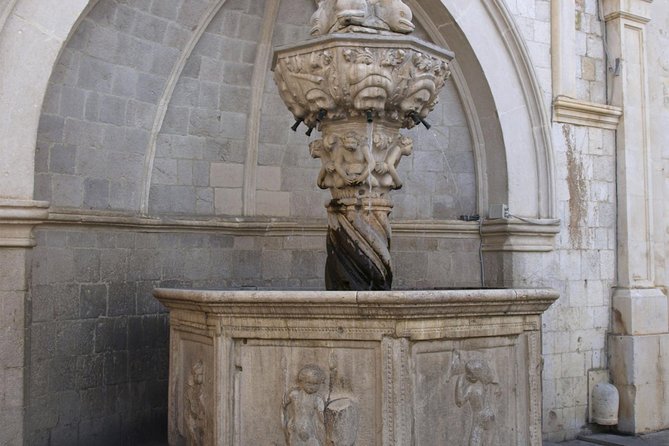
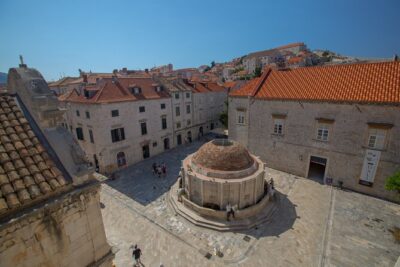
Next comes Onofrio’s Fountain, built in 1438. The key detail here is why it’s important: it was fed by an 8-mile (12-km) aqueduct that brought water to the city.
That means you’re not just seeing a fountain. You’re seeing the engineering that made daily life possible inside the walls. It’s a nice shift from war-and-monuments talk into the practical stuff: water, access, and how a prosperous port kept people alive.
Stradun, palaces, and the power centers you can actually picture
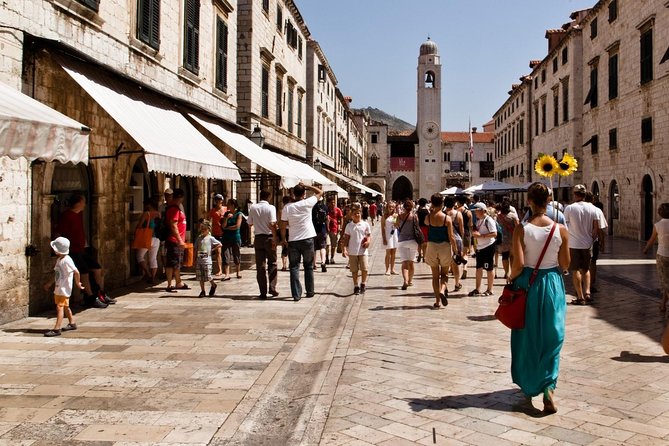
As the walk continues, you get the stretch many visitors imagine when they picture Dubrovnik: the central Old Town flow with big public structures nearby.
This is where I think the tour earns its strong ratings. You’re walking past major buildings like Rector’s Palace, Sponza Palace, and the Cathedral of the Assumption area, but with explanations that help you understand roles and timelines.
Rector’s Palace: where governance feels real
The tour highlights the Rector’s Palace, which is a centerpiece for understanding how Dubrovnik functioned. The “why” matters: you’re learning how power operated in the city, not just that a grand building exists.
Even if you only remember one idea after the tour, make it this: the most impressive architecture usually has an administrative job. In Dubrovnik, it’s not all church and fortifications. Civic life shaped what you see.
Sponza Palace: commerce and civic life in one view
Sponza Palace is another stop that tends to land well because it connects architecture to the everyday rhythm of a port city. It sits in the flow where people moved, traded, and watched public life unfold.
If you’ve ever walked through a beautiful square and felt like you’re missing the point, this is the fix. You get a guide tying the setting to how the city worked.
The Cathedral of the Assumption area after 1667
The Cathedral of the Assumption is explained as a baroque church built after the devastating earthquake of 1667. That detail is more than a historical date. It’s a reminder that Dubrovnik’s look today is the result of rebuilding and choices after major shocks.
In other words: you’re not only looking at “old.” You’re looking at old that survived, transformed, and got rebuilt.
Luza Square: the heart of the Old Town in one stop
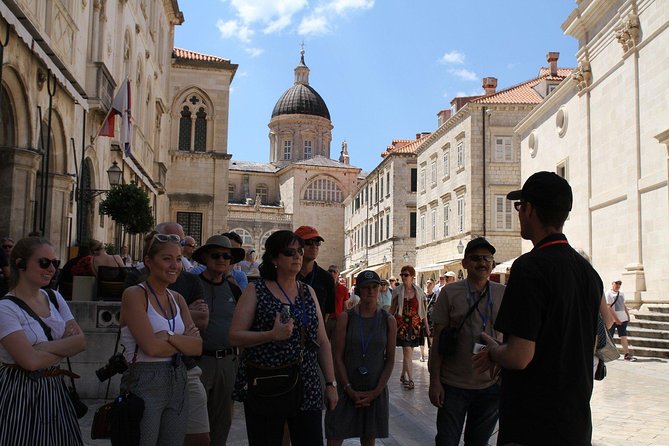
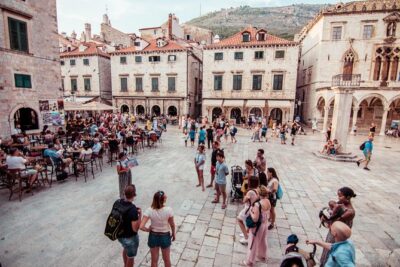
Luza Square is described as the main square, and the guide uses that space to anchor several landmark views.
Expect multiple features in view from here, including St. Blaise’s church, Orlando’s Column, Sponza Palace, the Small Onofrio’s Fountain, and the Bell tower. That mix is why the stop works: you get a mental map where all the symbols and structures link up.
This is a good moment to pause mentally, because it helps you stop treating Dubrovnik as random stops. Instead, you start seeing it as a connected set of public spaces.
Also, this is a short stop. So if you want photos, take them, then move on. You’ll see plenty more during the walk, and the tour pacing is built for keeping everything coherent rather than dragging out one spot.
Brsalje Street and Pile Gate: orientation without extra entry lines
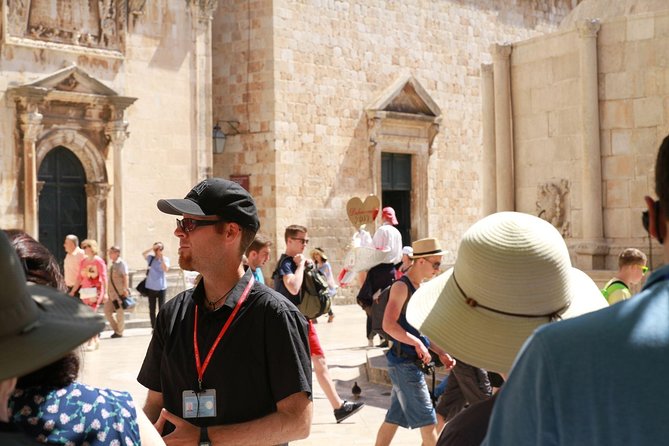
Two quick stops help you stay oriented.
Brsalje Street for a quick “what you’ll see” reset
At Brsalje Square, there’s a brief summary so you know what’s coming. You do not enter any facilities here. That’s useful if you’re the type who hates surprise dead-ends or suddenly standing somewhere without context.
It also helps if you’re arriving mid-day or you’re jet-lagged. A two-minute reset is often enough to get your attention back.
Pile Gate: the main western entrance
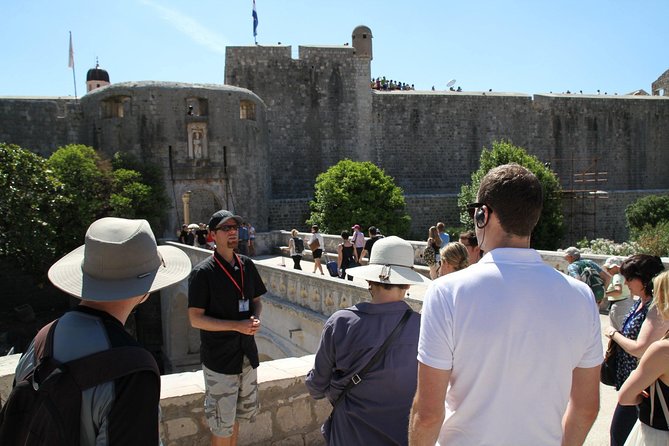
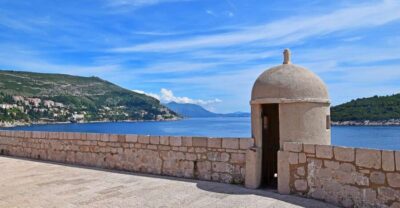
Pile Gate is the main western entrance to the Old Town. Seeing it early (and understanding it) helps you gauge the city’s scale and the way access worked.
This matters more than you’d think. Dubrovnik’s walls and entrances aren’t just backdrop. They’re part of how the city defended itself and managed movement in and out.
Porat Dubrovnik: ending near the water with easy next steps
The final stop is Porat Dubrovnik. It’s a short wrap-up area and a practical finishing point because it connects your Old Town walk to the port zone.
If you like continuing by foot, you’re already near one of the natural hubs for onward exploring. If you prefer to transition to something else, it’s also a convenient place to regroup.
Group size, pace, and why weather matters more than you think
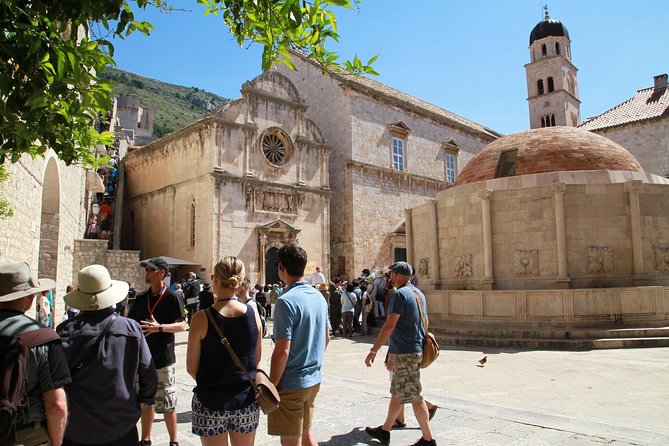
This tour has a maximum of 99 travelers, with a minimum of 4 needed for it to run. Audio headsets are used in groups of 4+, so even if your group is smaller, the format is designed to keep you from fighting street noise.
Pace is the other real-world factor. Multiple notes mention that the walk can feel fast when streets are crowded. That doesn’t mean it’s rushed overall, but it does mean you should come prepared to keep up for 1.5 hours.
Now add weather. The tour requires good weather. If it’s canceled due to poor weather, you’ll be offered a different date or a full refund. And if it’s raining but still running, expect stone walkways that can get slippery. I’d wear shoes with grip and keep your phone secured, not waved around mid-step.
What makes the guides so effective on this route
The strongest theme across the experience is how much the guide changes the quality of your walk. Names that come up include Branko, Lana, Davor, Branco, Goran, and Alex.
What’s consistent in the feedback: clear explanations, a pace that hits a lot of ground, and stories that don’t feel like they were copied from a textbook. Some guides also handle sensitive topics like the war in the 90s, including how it impacted their family personally, while still keeping the tour understandable.
So here’s my practical take: if you want a Dubrovnik walk that feels like a conversation with context, this is the format. If you want quiet sightseeing only, you may find guided commentary a bit too much.
Tips to get the most from your 1.5-hour walk
You’ll enjoy this tour more if you treat it like guided orientation plus photo moments, not a slow stroll.
- Go with comfortable, grippy shoes. Dubrovnik is beautiful, but the ground can be slick when wet.
- Arrive a few minutes early at Brsalje ul. 8 so you’re not stressed before the tour starts.
- If your group is large enough for audio headsets, use them. It makes a noticeable difference in crowded squares.
- Don’t try to mentally memorize everything. Pick a theme: water (Onofrio’s Fountain), power (Rector’s Palace), or rebuilding after 1667.
Should you book this Dubrovnik Discovery Old Town Walking Tour?
I’d book it if you want a fast, focused Old Town introduction that helps you understand what you’re seeing. The combination of a licensed local guide, audio headsets, and a route that connects Pile Gate, Stradun landmarks, Luza Square, and the port area is exactly what you need when Dubrovnik is your first Old Town stop.
I’d think twice only if you strongly prefer quiet time over explanations, or if you know you struggle with steady walking on stone streets in rain. If that’s you, consider doing your own self-guided wander on your best weather window and use a guide on a day when you can move comfortably.
If you want Dubrovnik to make sense in 90 minutes, this is a solid bet.
FAQ
How long is the Dubrovnik Discovery Old Town Walking Tour?
The tour lasts about 1 hour 30 minutes.
What language is the tour offered in?
The tour is offered in English.
Where do I meet the guide?
Meet at Dubrovnik Walks Orange umbrella, Brsalje ul. 8, 20000, Dubrovnik, Croatia.
Is the tour ticket a mobile ticket?
Yes, the tour uses a mobile ticket.
Are audio headsets included?
Yes. Audio headsets are used in groups of 4+ persons.
Which sites are part of the route?
The walk includes major Old Town sights such as Franciscan Monastery, Orlando’s Column, Onofrio’s Fountain, Rector’s Palace, Sponza Palace, and the Cathedral of the Assumption area, plus Luza Square, Pile Gate, and the Porat Dubrovnik area.
Is admission included for the stops?
The tour shows admission ticket Free for the stops listed, and it does not involve paid entries as part of the experience.
What if the weather is bad?
This experience requires good weather. If it’s canceled due to poor weather, you’ll be offered a different date or a full refund.
Can I cancel and get a full refund?
Yes. Free cancellation is available if you cancel at least 24 hours before the experience’s start time. If you cancel within 24 hours, the amount you paid will not be refunded.
Keep Walking the Old Town



The Walls & Old Town, More Ways In

More Tour Reviews in Dubrovnik


Fresh on the Dubrovnik shortlist





City Walls & Old Town, compared.
 ★ 4.8Old Town Walking TourFrom $235,174 reviews
 ★ 5.0Dubrovnik Old Town History Walking TourFrom $241,684 reviews
 ★ 4.8City Walls Early Morning or Sunset Walking TourFrom $291,523 reviews
 ★ 5.0Ancient City Walls & Wars Walking TourFrom $301,270 reviews
 ★ 5.0Dubrovnik Combo: Old Town & Ancient City WallsFrom $521,019 reviews
 ★ 4.9City Walls, Old Town Walking Tour & Adriatic ViewFrom $27982 reviews
 ★ 4.9Blue Cave Tour with Panoramic Old Town ViewFrom $73884 reviews
★ 4.9Old Town Walking TourFrom $23792 reviews
★ 4.9Blue Cave Tour with Panoramic Old Town ViewFrom $73884 reviews
★ 4.9Old Town Walking TourFrom $23792 reviews
Browse the lists this tour appears in